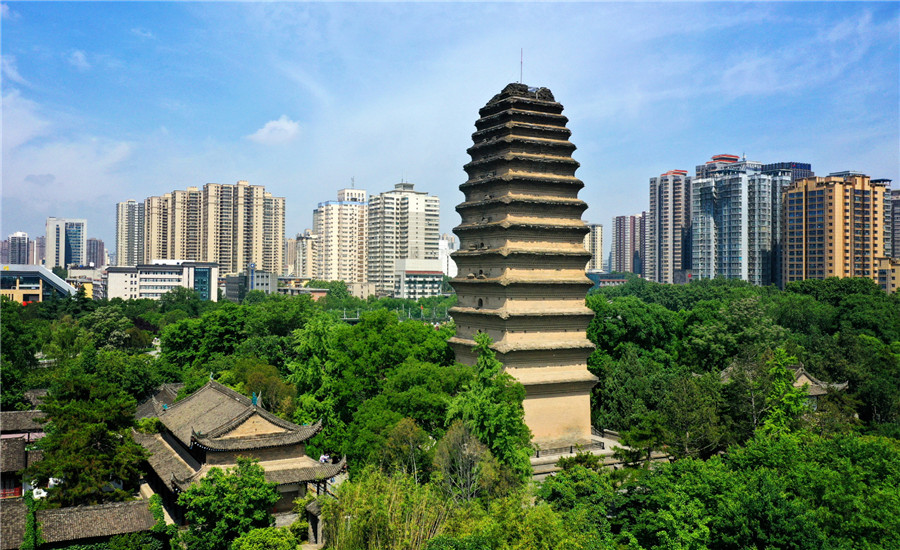
Chinese Buddhist Pagoda
Introduction
A Chinese Buddhist pagoda is a traditional tower-like structure that is often associated with Buddhist temples and monasteries in China. These pagodas serve both practical and symbolic purposes in the practice of Buddhism. China is home to numerous famous pagodas, each with its own historical and cultural significance. Some well-known examples include the Giant Wild Goose Pagoda in Xi'an, the Lingxiao Pagoda in Zhengding, and the Iron Pagoda in Kaifeng.
Pagodas are rich in symbolism, representing various aspects of Buddhist teachings. The shape of the pagoda is said to symbolize the Mount Meru, a sacred mountain in Buddhist cosmology. The multiple stories of a pagoda represent the different stages of enlightenment.
Historically, pagodas served multiple functions. They were used as reliquaries to house sacred Buddhist relics, as well as for meditation, chanting, and as places for pilgrims to pay their respects.
Historical Context and Origins
A "Buddhist pagoda" is a tiered tower with multiple eaves, prominent in various parts of Asia, including China, Japan, South Korea and Vietnam. Originating in what is now India, the pagoda evolved from the Buddhist stupa, a structure built to house sacred relics. Over time, the architectural style of pagodas was influenced by local traditions and aesthetics, resulting in various forms and functions.
The architectural inception of pagodas can be traced back to the 3rd century BC in India, where the stupa was a simple, mound-like structure primarily serving as a reliquary. As Buddhism spread across Asia, the stupa form was adopted, adapted and transformed into the more vertically elongated pagoda, reflecting each region's unique architectural preferences and cultural nuances.
Architectural Features
Buddhist pagodas typically feature an odd number of tiers, which are symbolic of the Buddhist cosmology. The structure often includes a spire on top, representing the path to enlightenment. The design of a pagoda is both functional and symbolic, with elements such as the finial representing the axis of the world and the eaves offering protection and a space for meditation.
The materials used in pagoda construction vary, from wood and brick to stone and metal, depending on the region and era. Intricate carvings and decorations are commonly found on the exterior of the pagoda, depicting Buddhist deities, symbols and stories. The craftsmanship involved reflects both religious devotion and artistic expression.
Chinese Buddhist pagodas are known for their unique architectural style. They typically have a tiered structure with multiple eaves and upturned edges. The number of stories can vary, with some pagodas having as few as three stories and others reaching over ten stories.
Cultural Significance
Pagodas serve not only as religious structures but also as cultural landmarks that embody the fusion of local traditions with Buddhist philosophy. They are often part of larger temple complexes and serve as places for worship, pilgrimage and community gatherings. The artifacts found within and around pagodas, such as statues, bells and ritual implements, offer a window into the spiritual and everyday life of the people who built and used them.
Preservation Efforts
Today, many ancient Chinese pagodas are subjects of preservation and restoration efforts. The Yuanying Pagoda in Shanghai, for instance, underwent a major restoration process, ensuring its structural integrity and historical authenticity. Exhibitions showcase the artifacts and tell the stories of these pagodas, bringing their history to life for modern audiences.
Modern pagodas continue to be constructed, maintaining the traditional architectural elements while sometimes incorporating contemporary materials and techniques. They remain important symbols of cultural identity and continuity in the regions where they are found.








